Choosing plants for a hedge: screening, clipping and coastal wind
5 min read
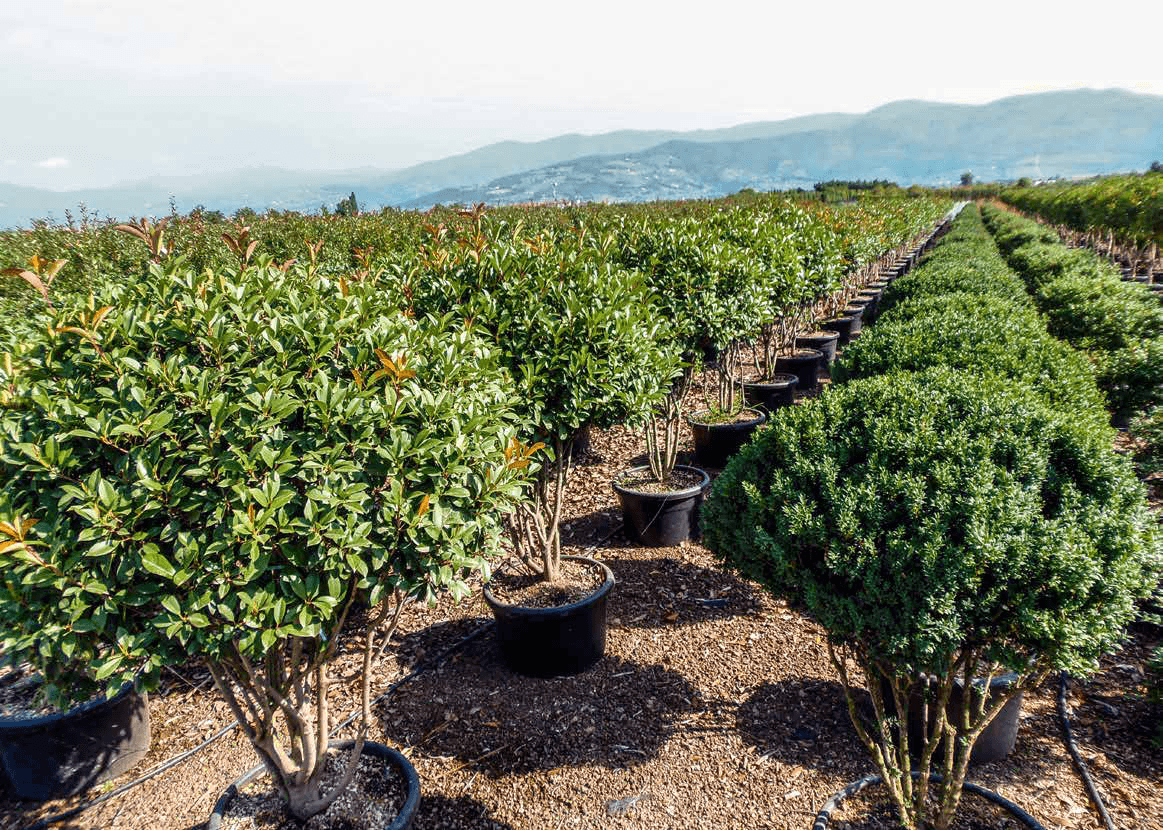
Which hedging plants suit which job — fast evergreen screening, a formal clipped line, or a windbreak on the coast — with spacing, clipping months and honest trade-offs.
A hedge is the one piece of planting that has to work every day of the year. It holds a boundary, takes the wind off a terrace, hides a neighbour's garage and gives the rest of the garden a background to sit against. Most disappointing hedges are not the result of bad plants but of the wrong plant given the wrong job: something chosen for speed where density was wanted, or a lowland shrub set on a thin limestone slope two hundred metres from the sea.
Decide what the hedge has to do
Settle the brief before the species. How high does it need to screen, will the line be clipped to a flat face or left informal, how much wind does it take, and how many cuts a year will actually get paid for. A hedge is a maintenance commitment as much as a plant, and the species that closes fastest is rarely the one that stays presentable with the least work.
- Screening: evergreen, furnished to the ground, usually 1.8 to 2.5 m finished, one or two cuts a year.
- Formal architecture: small leaf, tolerant of hard clipping, slow enough to hold a crisp face between cuts.
- Shelter: a canopy that filters wind rather than a solid wall, which only makes turbulence on the leeward side.
- Boundary marking alone: deciduous, cheapest per running metre, three plants per metre in a single line.
Evergreen screening that closes quickly
For a screen that has to do its job within three or four seasons, the reliable broadleaves in continental Croatia are Ligustrum, Photinia and Prunus laurocerasus, planted three per running metre in a single line, or two per metre in a staggered double row where the site is wide enough. Photinia x fraseri 'Red Robin' takes clipping well and pushes red growth after each cut, but it wants air movement: planted tight against a wall in still, humid ground it picks up leaf spot. Prunus laurocerasus 'Rotundifolia' is the fastest of them and will screen at 2 m in three years, at the cost of a coarse leaf and two cuts a year taken with secateurs rather than a trimmer if the cut leaves are not to brown at the edges. Cupressocyparis leylandii closes faster than anything else available and is genuinely useful on an exposed rural boundary, but it has to be clipped twice a year from the start, in June and again in late August, and it will never regrow from old bare wood. A leylandii hedge cut back into brown wood stays brown.
The clipped hedge: yew, box and hornbeam
A formal hedge is a different plant altogether. Here slow growth is the point: the face stays sharp for longer and the annual cut is one afternoon rather than three. Taxus baccata is the best clipped evergreen available to us, dense, dark, indifferent to shade, and the only common conifer that reliably regrows from old wood, which means a neglected yew hedge can be cut back hard and recovered. It asks for drainage; yew planted in a hollow that stands wet through winter thins out and goes bronze. Buxus is still the correct plant for a low edge under 60 cm, with the caveat that box moth and box blight are now widespread and the planting has to be watched. Where a garden wants a green wall in summer and bare structure in winter, Carpinus betulus is cheaper per metre than any evergreen and, when clipped, holds its russet leaf through most of the winter.
- Taxus baccata: 3 plants per running metre, one cut in late July or August, hard renovation into old wood possible.
- Buxus sempervirens: 5 to 6 plants per metre for an edge under 60 cm, clipped in May and again in early September.
- Carpinus betulus: 3 per metre, one cut in July; it holds dry russet leaf through winter and breaks cleanly in April.
On the coast: wind, salt and thin soil
Along the Adriatic the limiting factors are salt-laden bura, summer drought and a soil that is often 20 cm of red earth over rock. Broad soft leaves burn; small, leathery or silvered ones do not. Elaeagnus x ebbingei is the most forgiving screening shrub on an exposed sea-facing boundary, holding a dense evergreen face, taking salt spray, and growing on ground that would kill cherry laurel. Pittosporum tobira is slower but denser and makes a solid clipped block at 1.5 to 2 m; the dwarf form is useful where a low wall of foliage is wanted along a path. Viburnum tinus gives an informal, unclipped hedge that flowers from December to March, which matters in a garden used in winter. Laurus nobilis is the classic clipped Mediterranean hedge, tolerant of hard cutting, and it will also grow in the continental interior in a sheltered courtyard, though a hard inland winter can take it to the ground, after which it resprouts from the base.
Whatever the species, the hedge is made in the first two years. Dig a trench rather than individual pits, set the plants at the depth they grew in the container, and mulch the whole line. Water through the first two summers even on the coast: a hedge that has taken hold by its second year will look after itself for thirty, and one left dry in year one stays uneven for the rest of its life. Start cutting early, while the plants are still short. The dense base that makes a hedge worth having is built in those first cuts and cannot be produced by any amount of clipping later.
More from the journal
Japanese maples: choosing a cultivar and finding the right spot
Acer palmatum in Croatian gardens: sun and shade, leaf scorch, soil pH, container culture, and which cultivars stay small enough for a town garden.
The olive in the garden: coast, container and continental frost
How Olea europaea behaves in Croatian gardens — the coast, the wet continental interior, container culture, pruning, and what a mature specimen actually buys you.